
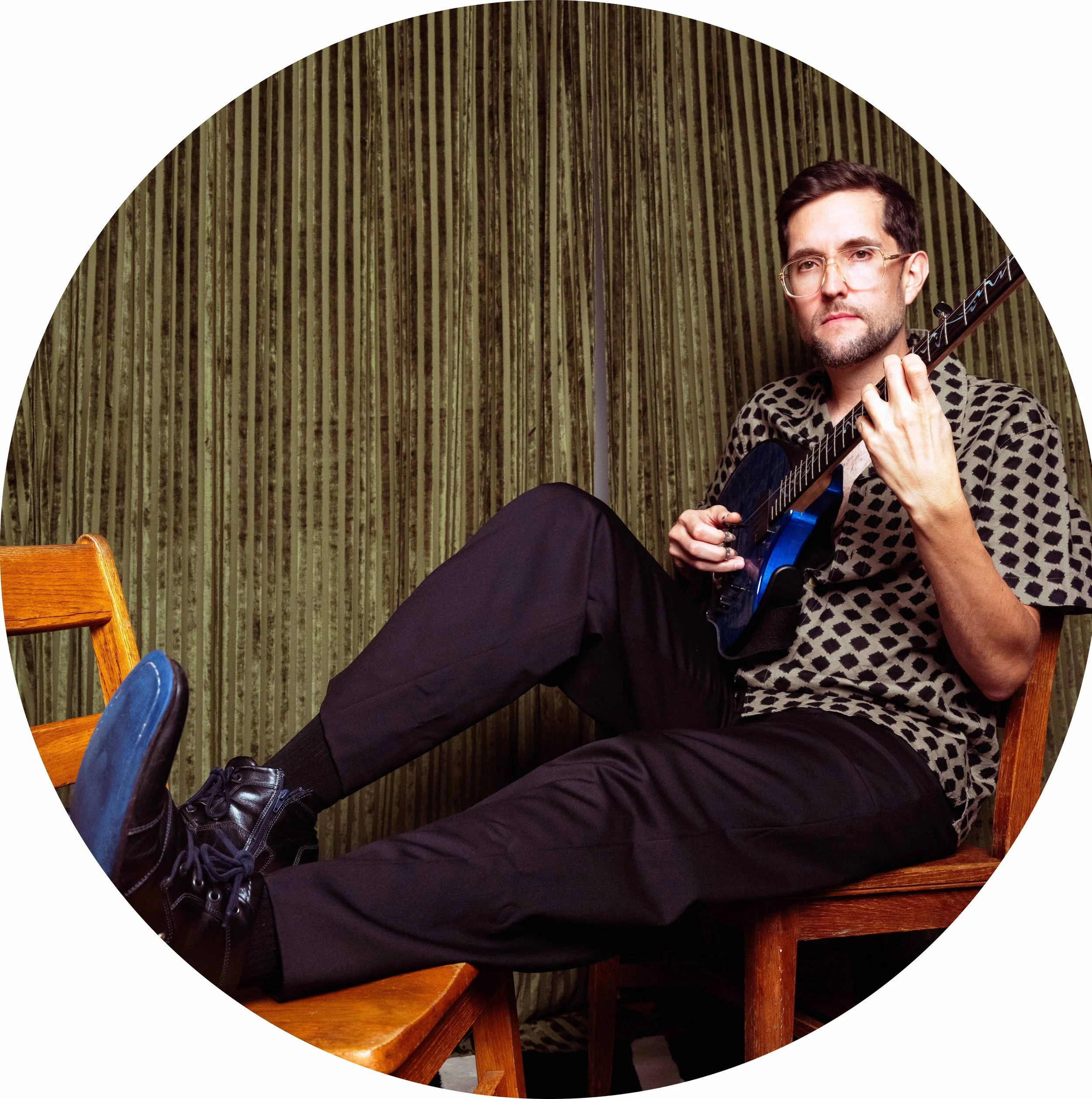
ABOUT JOE TROOP
Hey yaw! I’m Joe. I was born and raised in the North Carolina Piedmont of the Southern United States. And after many years of globetrotting, it’s once again my home base. I play several instruments from the string band traditions of my stomping grounds, but the banjo is my focus. I like it because it’s the byproduct of chaos, just like me.
I am most known for two of my projects: Che Apalache, the GRAMMY-nominated “latingrass” quartet I founded with three of my students in Buenos Aires, and Larry & Joe, the panamerican folk duo I founded with brilliant Venezuelan asylum seeker Larry Bellorín here in North Carolina. Che Apalache was forced into hiatus by COVID, but we have a reunion tour planned for 2027. I currently play all over the US with Larry & Joe, and I lead two quintets that play my original music and tour regionally, the Truth Machine (bluegrass for social justice) and Whirlwind (electric banjo fusion defying categorization). Most recently I’ve thrown a solo banjo and storytelling show into the mix. I like to stay busy.
A chance encounter with an Appalachian musical legend was what started me down this path. My older brother and I took a weekend road trip up to the high country when I was 14, and along the side of the road in a village called Deep Gap we saw a sign outside of a restaurant, “Live Music Tonight: Doc Watson and friends.” We wound up in a little country diner literally across the table from Doc and his community as they jammed. Lighting bolts shot through my imagination! I instantly knew what I wanted to do with my life. The next summer I got my first banjo from a Winston-Salem pawn shop.
As a teenager there weren’t enough hours in the day to satiate my curiosity. I quickly became proficient enough to gig regularly. My focus was learning traditional bluegrass and oldtime, but Béla Fleck was my banjo hero. He proved the instrument could work in all kinds of settings. His “Tabula Rasā” collaboration with Indian and Chinese musicians sent me down a rabbit hole, and being that this was the late 90s, I eventually found the world music section at a local CD store. And that was that! I began obsessively listening to music from other countries and rejoiced in hearing songs in foreign languages. A question began to take root. “Why the hell shouldn’t I learn another language or two?” I felt an unconventional path unfolding, and I went for it.
At age 19 I moved to southern Spain for two revolutionary years in a study abroad program. I immediately stumbled into the heart of the Sevilla flamenco scene, a network of underground tablaos. Concurrently I met an Argentinian street busker playing the bandoneón and asked him to teach me his folk music. We formed a tango duo, and through him I met my core group of friends, a family of recent immigrants from Buenos Aires. They basically adopted me. To this day we are like family.
There wasn’t a hat I wouldn’t try on during this formative era of my life! I got plugged into the local Irish and Manouche jazz scenes. I joined a Palestinian/Israeli ensemble for a UK tour. I befriended a group of Japanese people learning flamenco and Spanish like me, and I began formally studying their language. I wanted to absorb the entire planet!
Living in Spain also allowed me to hop around the Mediterranean region a bit. I spent summers studying a squirrelly dialect of Arabic in Morocco, discovering all kinds of mesmerizing Jebala kamanja fiddling. I made a lengthy trip to Rennes to visit my French roommate’s family and learn a second Romance language. These couple years were an explosion into learning which laid the groundwork for everything I’ve done since.
After college at 22, hell-bent on upping my language chops, I landed a two year stint teaching English in a remote village of the Japanese Alps and plunged headfirst into a highly idiosyncratic and wonderful regional culture. I was the only Westerner in the 600 person village (Kamimura, Nagano Prefecture). While there I discovered minyou and the shamisen. On weekends I was able to venture out and network with people in other areas. Believe it or not, there is a huge bluegrass scene in Japan, mostly in cities. I traveled far and wide attending festivals and jam sessions, which allowed me to understand the vast differences between the country’s rural and urban areas.
At 24 I returned to the US to join a touring bluegrass band, but after a couple years, the allure of South America was irresistible. In 2010 at age 26 I sold all my stuff on a whim, packed up a banjo and fiddle and moved to Buenos Aires, where I lived for a decade.
Argentina is where my artistic voice began to emerge. To pay the bills I taught hundreds of students banjo, fiddle, mandolin and guitar by day. By night I immersed myself in the city’s vibrant music scene. I saw top notch tango, milonga, chamamé, chacarera, rumba cubana, joropo, jazz... The list goes on and on. In my late 20s and early 30s, my principal project was a duo with prodigious double bassist, Diego Sánchez. We cut a couple albums of eclectic original material together and had an impressive cult following in the BA underground.
In 2016 I founded a bluegrass band called Che Apalache with my three prize pupils. We decided to explore Latin American folk on Appalachian instruments and cut an album in 2017 called “Latingrass,” which was a hit in the US. In 2018 we caught the ear of my childhood hero Béla Fleck, and he signed on to produce our second album, “Rearrange My Heart," which was nominated for a 2019 GRAMMY for Best Folk Album.
Che Apalache was bouncing back and forth between Argentina and the US until March of 2020, when the pandemic shattered our operation and forced us into hiatus. We happened to be in the US when the shit hit the fan. Split second choices were made. My bandmates fled to their respective countries of Argentina and Mexico, and I decided to ride things out in North Carolina. I went from constant international touring with a successful band to being stuck back in my stomping grounds, living out of my minivan during a plague. This is when my life took an unexpected trajectory.
With Che Apalache I had written a couple songs for social justice, against the border wall and in favor of immigration reform. In April of 2020 a rural organizer familiar with my work commissioned me to write a song in defense of the US Postal Service, which Trump and his cronies were trying to defund. The song did very well and got national media attention. This success helped me land a gig working on a get out the vote campaign, an attempt to engage rural progressives in my home state in that year’s elections. I was hired to host a webdoc series called “Pickin’ for Progress,” interviewing leaders from across North Carolina and curating music for each of the 15 weekly episodes. I pumped out new music like a mad man, which culminated in my 2021 album “Borrowed Time,” featuring an epic cast of collaborators including Béla Fleck, Abigail Washburn, Tim O’Brien, Charlie Hunter and twenty-some buddies from the Southern US.
My hard work during the pandemic established me as an artivist and caught the eye of organizers on the Mexico-US border. In the summer of 2021 my film crew and I were invited down to a shelter for asylum seekers in Nogales, Sonora, Mexico to document the atrocities happening in the borderlands, and to make a music video for my song, “Mercy for Migrants.” These efforts got national media attention and more importantly raised significant money for the shelter itself.
Aware of my work down in Mexico, a friend and professor of music at Duke University in North Carolina contacted me in the fall of 2021. She said, “You’re a career musician working with asylum seekers. Well, you ought to meet this brilliant asylum-seeking migrant musician working construction in your home state.” Through her I met my musical soul brother, Raleigh-based Venezuelan folk legend Larry Bellorín. We collaborated on a residency in December of that year, sparks flew, and I decided to put down roots in Durham to pursue the duo full time. Larry was soon off the construction site, and in the past 4 years we have played more than 400 gigs in 39 US states and have cut two albums, “Nuevo South Train” and “Manos Panamericanos.” I wish we could take our project abroad, but as I write this in 2026, we’re tied here. If Larry leaves the country, they won’t let him back in.
Now I’m in my 40s, lots of years and miles traveled behind me. I love collaborating with other artists and being a band leader, but I also feel compelled to stand on stages alone and retrace my steps. Over the past couple of years I’ve developed a solo banjo and storytelling show.
With just a five-string resonator banjo and my voice, I share tales and aural sketches of the people, places and musical cultures which have influenced my art.
As I write this bio, all five of my projects are in rotation and touring across the United States. Hope to see you out there somewhere!
- Joe